Three cutoffs, one view
Compare 100, 200, and 500 ng/mL instead of assuming every lab uses the same threshold.
Understand cutoffs →Use this free EtG calculator to explore research-informed urine detection ranges across 100, 200, and 500 ng/mL cutoffs. No signup, no stored answers, and no misleading “guaranteed pass” result.
Enter what you know. We’ll show a range, not a false promise.
Urine EtG varies too much for a responsible calculator to promise a precise concentration. We translate research into an understandable range and show what could move it.
Compare 100, 200, and 500 ng/mL instead of assuming every lab uses the same threshold.
Understand cutoffs →See an earlier-to-later window and the factors that create uncertainty around your result.
Read the methodology →Your entries and result remain in your browser. There is no account and no calculation history.
Privacy details →EtG is a direct alcohol metabolite that can remain measurable after breath or blood alcohol is gone. The chance of detection generally decreases with time, but drinking amount and the test cutoff change the shape of that window.
Explore detection-time evidence →Illustrative only. This is not a personalized test prediction.
Explore tightly focused guides written around the entities that matter: ethyl glucuronide, ethyl sulfate, ethanol, urine creatinine, laboratory cutoffs, and standard drinks.
In-depth articles connecting alcohol-biomarker research to how EtG results are actually used and interpreted.
How probation, workplace, and recovery-monitoring programs use EtG testing, why a lab number is not the same thing as a program decision, and what evidence-informed program design looks like.
By Dr. Frederick · 9 minute read →The science behind the test02A plain-language look at the biochemistry behind the EtG test: how a minor ethanol pathway became one of the most specific tools for detecting recent drinking, and what the science still cannot tell you.
By Dr. Frederick · 8 minute read →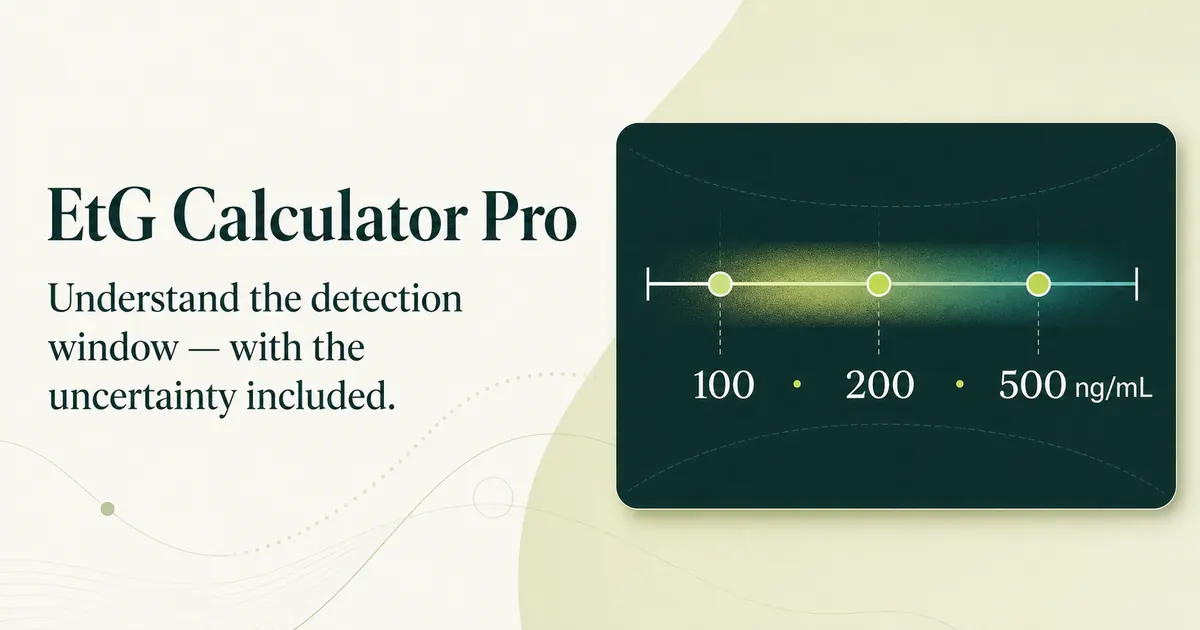
Turn serving size and ABV into standard drinks, then calculate exact elapsed hours between the end of drinking and a test date.
Clear answers to the questions most calculators leave unresolved.
Detection varies widely. Research shows that dose, time since drinking, testing cutoff, repeated drinking, kidney function, and urine concentration all matter. A higher 500 ng/mL cutoff is generally less sensitive than 100 or 200 ng/mL.
It is better understood as a possible upper-end window, especially after heavier drinking—not a guarantee that every exposure remains detectable for 80 hours. Studies show sensitivity falls over time and changes substantially with the cutoff used.
No. A calculator cannot know your measured urine concentration or guarantee a test outcome. This tool shows an evidence-informed range and uncertainty rather than a pass/fail promise.
These are laboratory reporting cutoffs. Lower cutoffs can detect more exposures for longer, but are more sensitive to incidental alcohol exposure. Higher cutoffs reduce some incidental positives but can miss more drinking events.
Water can dilute a urine sample but does not reliably speed the body's elimination of EtG. Laboratories may check creatinine or sample validity, so dilution is not a dependable strategy.
Your entries stay on your device. Results are educational, never guaranteed.